How to Find a Market Where Your Strengths Matter
A business strength becomes an advantage only where customers need it and the company can use it well. A practical reading of distance, difficulty, breadth, and viability in Sun Tzu's first chapter.
Imagine a home-services company known for listening carefully, earning trust inside people's homes, and matching the right worker to each job. The owners see a chance to sell services to manufacturers, where contracts look larger. Their people skills may still help—but manufacturing customers will also expect reliable production, quality control, and equipment knowledge. The company's best-known strength does not automatically answer those needs. The question is not whether the team is good. It is where its particular abilities make life easier for customers, and where the business can deliver them well.
A strength needs somewhere to work
We often talk about a company's strengths as if they travel unchanged. A founder says, “We are great with people,” or “Our team is good at strategy,” then looks for the next industry to enter. But a strength is useful only in relation to a real task. A skill customers do not need in that situation may remain impressive and still fail to help the sale.
In home services, listening and trust can matter because a worker enters a customer's home, learns what is needed, and has to do the job with care. In manufacturing, those same qualities might help with customer relationships, but they do not replace a dependable production process or technical quality control. The company would need to build, hire, or partner for the abilities the new work demands.
That is what we mean here by finding ground where your strengths fit: choose a particular group of customers and a particular kind of work where what you already do well solves a problem they care about. The fit must work for both sides. The customer gets something valuable; the company can provide it without exhausting its people or finances.
What ‘ground’ means in the first chapter
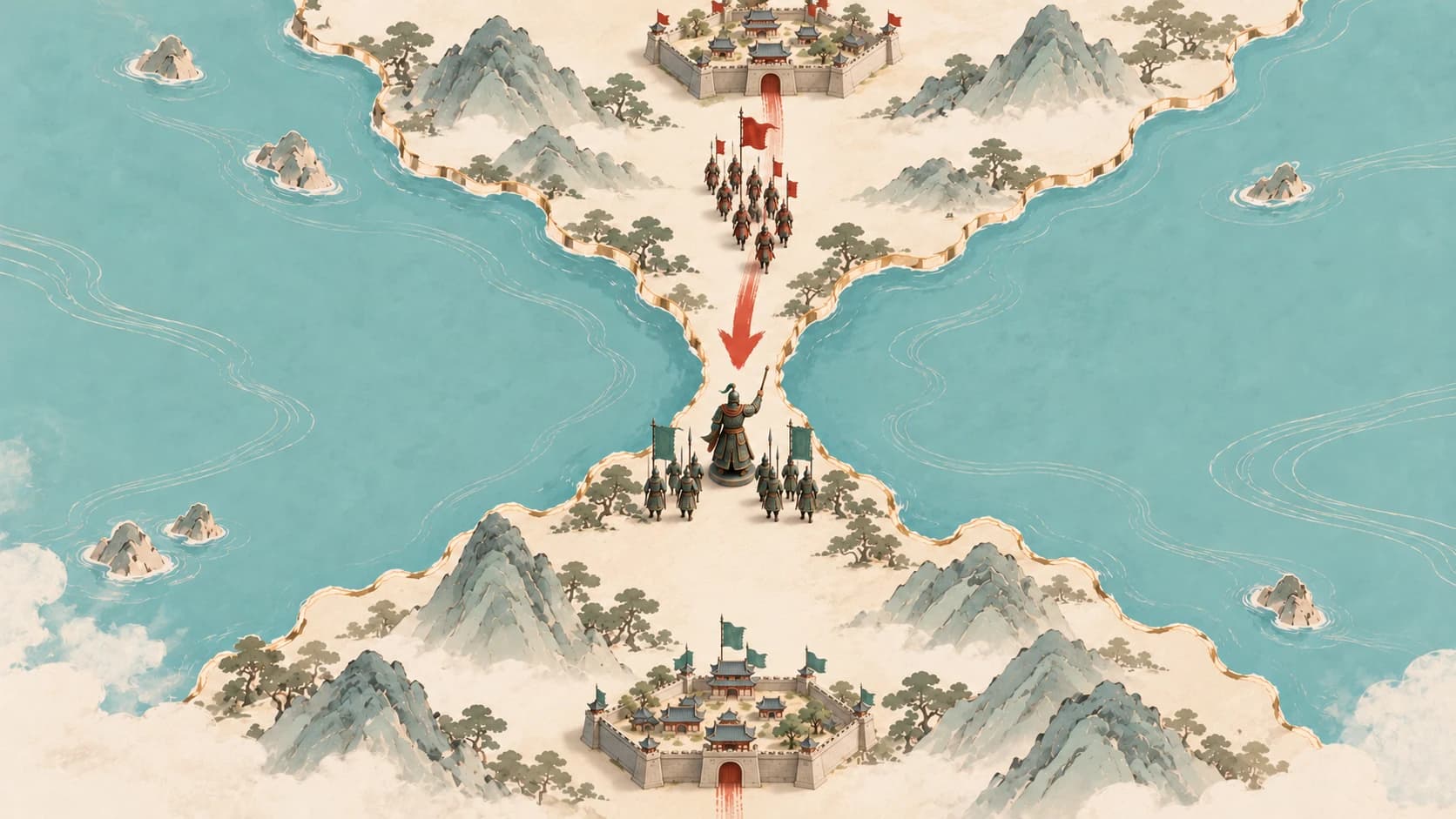
In the first chapter, Sun Tzu lists the ground—地者,远近、险易、广狭、死生也—among the conditions to examine before acting. In the military setting, these words describe features of the campaign ground: how far away it is, how difficult or easy it is, how open or constrained it is, and whether it offers a viable position or exposes an army to danger.
Our earlier explanation of the five matters in Chapter 1 reads 地 in that original setting: as the actual conditions on the ground, alongside purpose, timing, command, and organization. Applying these four contrasts to modern markets is an analogy. Sun Tzu was not writing a business-market checklist.
The analogy is still useful. Before a company asks how to use its strengths, it can ask where those strengths will travel easily, where customers can feel their value, how wide an opening to enter, and whether the business can keep moving once it gets there.
Distance: how far is the customer from you?
In a campaign, distance affects the effort and time required to reach a place. For a business, the distance may be physical, but it can also be the number of steps between the company and a customer: finding one another, understanding the problem, agreeing on the work, delivering it, and learning whether it helped.
A familiar Chinese saying captures one side of this: the pavilion nearest the water sees the moon first. In business, the advantage may be a shorter, easier route to customers—not simply being physically nearby.
A local cleaning company may already know the neighborhoods it serves, understand how homes are arranged, and earn introductions through satisfied customers. That is a kind of nearness. A factory in the same city may still feel far away if the company has no relevant contacts, does not understand its buying process, and cannot reach the person who chooses suppliers.
Nearness is not a claim that customers will automatically come to you. It is a practical question: do you have a less difficult path to the people who need this work than you would have in another market? Existing trust, useful relationships, a convenient delivery route, or first-hand knowledge may shorten that path. Evidence might be a real referral, a repeat order, or a conversation with the person who actually buys.
Ease and difficulty: who has to work hardest?
A job can be difficult for a customer and comparatively straightforward for one company. That gap can create value. Perhaps a customer struggles to coordinate several home repairs, while a service company already has the people and scheduling habits to manage them together. Or a team can make a complicated report clear because it has spent years doing that particular work.
The useful comparison is not simply “Are we capable?” Ask what is hard for the customer, what is hard for us, and what is hard for the alternatives they use today. Then compare the risks: can we test this with little money and time, while another provider would need to make a much larger commitment? A company may enjoy the craft and still spend so much time finding each customer that it cannot earn a living. Another may see strong demand but discover that delivery requires equipment, training, or risk controls it does not yet have.
A promising fit often makes a painful task easier for the customer without making the work unsustainable for the provider. That balance needs to be checked in real jobs, not inferred from a pitch. Compliments are encouraging; paid trials, repeat requests, and referrals are stronger signs that the value is being felt.
Breadth: start narrow, but know what lies beside it
A company can serve a broad market or begin with a much smaller group. Starting narrow may let a small team learn one customer's problem deeply and become known for solving it. A strategy consultancy, for example, may understand software companies well. “Technology” is still a large label, so it may need to narrow further: a certain stage of company, a specific growth problem, or a type of leadership team.
The same consultancy could also work with local service businesses. Some strategic skills may carry over, but customer acquisition, day-to-day operations, margins, and the decisions owners face can be different. A move into a new segment is a hypothesis to test, not proof that the old expertise will transfer unchanged.
Breadth is about the size and scope of the field you choose. Competition is a related but separate question: a large market is not automatically a red ocean, and a narrow niche is not automatically blue. A small niche can be crowded; a broad field can contain underserved groups. Look at both the reachable size and the actual alternatives customers have.
A focused starting point can become a useful foothold if nearby needs share some of the same customers, skills, or delivery system. A niche becomes concerning when there is too little paid demand to support the business and no credible next group to serve. Small is not the same as dead; a narrow market may be a stable home if it supports the life the business is meant to have.
Life and death: can the business keep its options?
In the original military context, life and death describe whether the ground supports survival or leaves an army in danger. As a modern business analogy, this becomes a question of development potential: can the company earn enough to continue, learn, and find its next move—or are cash and time draining while every route forward closes?
A market can look exciting and still be dangerous for a particular company. Reaching its customers may cost too much. Serving them may require a long, expensive build before anyone has agreed to buy. One customer may account for nearly all the revenue. Sales may arrive, yet every job may lose money. The size of the opportunity does not by itself protect the business from those conditions.
Conversely, a small first market can be a living position when customers pay, delivery becomes easier with practice, and a plausible next segment shares enough of the same ground. Growth is possible, not promised. The company has to earn it by showing that the original strength solves the next group's problem too.
A business reaches dead-end conditions when it cannot move forward or change direction while its resources keep shrinking. That may happen in a tiny market with no repeat demand or adjacent customers; it can also happen in a huge market that the company cannot reach affordably. The label describes the company's position and lack of options, not a judgment that small markets are worthless.
Compare two markets before you commit
Write down two specific customer groups and the work each needs done. For example, compare the households your service team already knows with manufacturers it hopes to serve. Use the same four questions for both. Mark only what current evidence supports; leave a question open when you have not checked it. The comparison is a prompt for better research, not a score that can guarantee success.
The evidence may point in different directions: one market may be easier to reach while another has more room to grow. Do not count the four answers as equal votes. First check the minimums: can you reach customers, deliver reliably at a viable cost, and afford to test? Set aside an option that fails a must-have. If both remain viable, name the priority that matters now—protecting cash, learning quickly, or making room to grow—and compare the evidence against it. If the choice is still unclear, run a small paid trial against the riskiest assumption. Decide beforehand what result would make you continue, stop, or adapt; if affordable, test both markets under comparable conditions.
Where can your strength do more useful work?
Compare two real customer groups. Use what you know today, and leave a question open when you have not checked it.
What the comparison says so far
- DistanceNot checked yet
- Ease and difficultyNot checked yet
- BreadthNot checked yet
- Staying powerNot checked yet
Who can introduce you to buyers in each market, and how many steps does it take to reach a real conversation?
This is a modern business comparison, not a translation of Sun Tzu's military terms or a scorecard. The selections reflect your judgment; the evidence notes stay in this page and are not submitted.
4 of four market questions remain unchecked.Test the ground before building a road across it
A market sketch is a starting point, not proof. The U.S. Small Business Administration's market-research guidance similarly asks owners to look at demand, market size, location, saturation, pricing, and the alternatives customers already use. It also distinguishes existing information from direct research with customers. Those checks will not predict a company's fate, but they can expose assumptions before a large commitment.
Choose one small test that could change your mind. Offer the service to a handful of suitable customers. Ask what they do now, what they have already paid to solve the problem, and what would make them switch. Track the time and cost of delivery, not just whether the conversation felt positive. For a method of checking claims and separating observations from assumptions, see our practical evidence checklist for competitive intelligence.
Set a review point before you begin. If customers value the work, pay for it, return, and tell others—and if delivery becomes more manageable as the team learns—you may have found ground worth developing. If interest stays polite, costs stay high, or every new customer requires a different business, change the offer or test another segment.
This is how a small foothold might grow: not because a niche guarantees expansion, but because the company learns what customers value and finds adjacent work that uses the same strengths. A new segment may still require new people or methods. Growth is a sequence of decisions, each made with better knowledge than the last.
Choose the place where your strengths become useful
The lesson of the market analogy is not “do what you are already good at” or “find the biggest blue ocean.” It is to put your abilities beside a real customer problem and ask whether the match can work in daily practice. Can you reach the people? Can you make their difficult task easier? Is the first field focused without being a trap? Can the company afford to learn and keep its options?
When a company reaches the right people, solves something they genuinely need, and does the work well, customers may return or recommend it. Those responses are not guaranteed by a slogan about strengths. They are signs to observe and verify.
Sun Tzu's original passage describes the ground of a military campaign. This modern extension asks a business to look just as concretely at where it is trying to operate. You do not need to begin with the largest territory. Begin where your strengths matter to someone—and where there is room to take the next step.
Name one customer group where your team already makes a difficult job easier. What evidence shows that this group can be reached, served sustainably, and possibly followed by a nearby market?
Chinese original and the creator's independent translation, Chapter 01.
Open the source chapterFurther reading
- The Art of War, Chapter 1: Laying Plans — Chinese Text ProjectOriginal text and Lionel Giles's English translation. The business-market reading in this article is a modern analogy, not a literal translation.
- Market research and competitive analysis — U.S. Small Business AdministrationA modern reference for checking customer demand, market scope, location, saturation, pricing, and competing alternatives. Consulted 8 October 2026.