Where the Costs of War Flow
A source-linked Sankey reading of Chapter 2 follows grain, mobilization, transport, military upkeep, and the people who bear the costs.
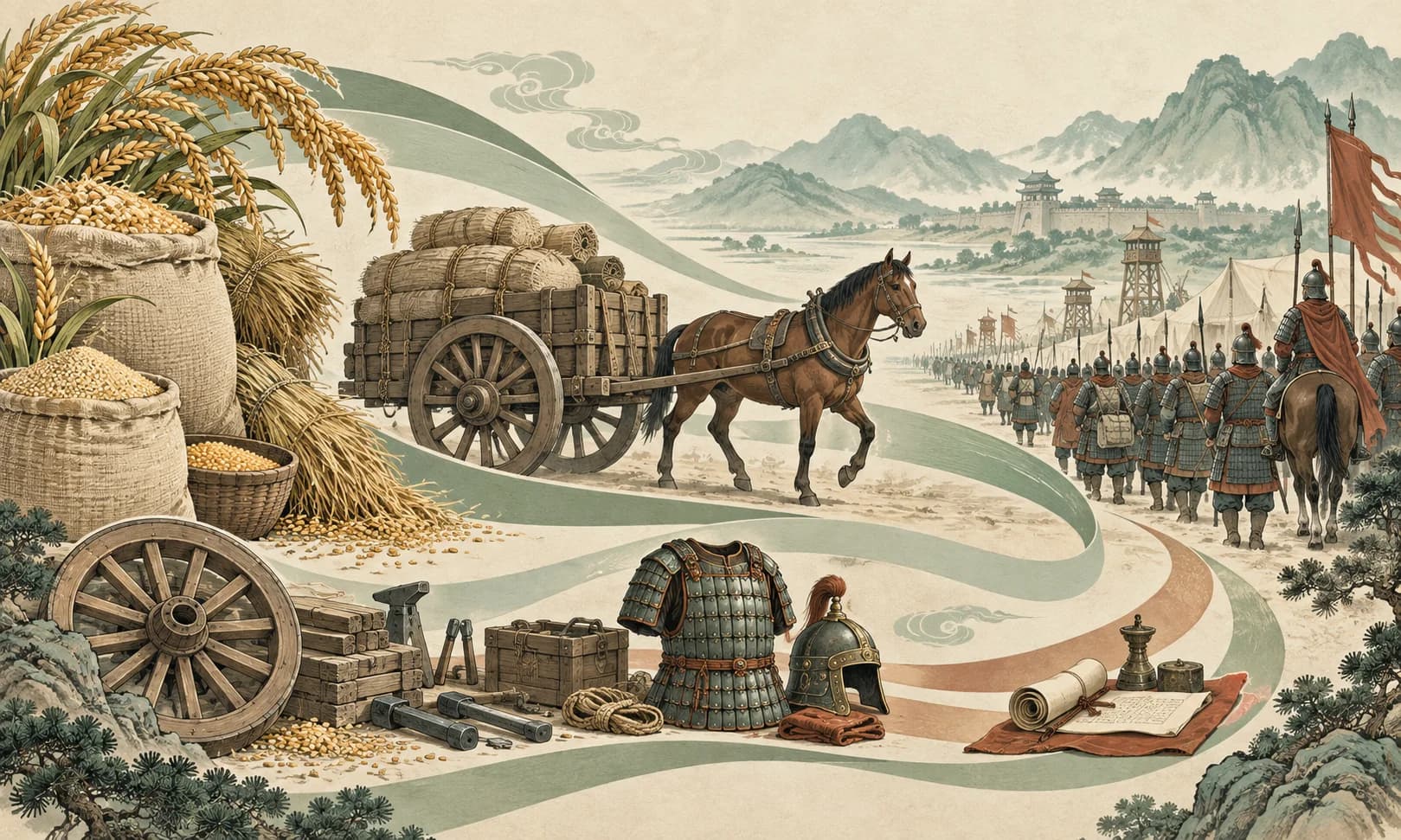
Editorial interpretation for review. Separate from the creator's translation.
The second chapter of Sun Tzu's The Art of War traces the resources a campaign draws on, the costs of supplying it, and the pressure it returns to households and the state. This Sankey groups those flows by textual emphasis and links each route to its source passage; it does not assign historical budgets where the text gives none.
At a glance
Where the campaign draws and spends
Follow resources from home and the field, through the campaign, to the army and the people who bear its costs.
All routes are visible. Select a source, cost, or outcome to trace its links and open the supporting passage.
Chapter 2 does not itemize intelligence costs. For the book's discussion of intelligence, see Chapter 13, “Use of Spies”.
War begins with a supply chain
The opening inventory names people, chariots, transport, and provisions carried over distance: 驰车千驷,革车千乘,带甲十万,千里馈粮. The point is not simply the scale of the army. A campaign starts by drawing on several kinds of capacity before a battle begins.
Use the diagram to compare each route. Grain and campaign supply receive the greatest visual emphasis, followed by the other categories named in the chapter. Ribbon widths express this qualitative reading, not amounts or percentages: the text does not give an itemized budget.
Daily costs spread across the state
The chapter lists domestic and external expenses, hospitality for envoys and advisers, materials for repairs, and the upkeep of chariots and armor: 内外之费,宾客之用,胶漆之材,车甲之奉,日费千金. These are different demands on the campaign, not rows in a modern accounting ledger.
The diagram keeps the cost of mobilizing an army distinct from the cost of maintaining it. That distinction matters: a plan may be able to assemble a force while still being unable to sustain it.
Distance shifts pressure onto households
Sun Tzu connects long-distance supply to hardship at home: 国之贫于师者远输,远输则百姓贫. The next lines describe prices rising where the army passes and household resources being drained.
The text's chain is explicit: 近师者贵卖,贵卖则百姓财竭. In the map, the long route therefore has a second consequence beside feeding the army: pressure returns to the people and places that support it.
Time turns expense into strategic exposure
A prolonged campaign is described through linked losses: troops become dull and weary, strength is spent, and state funds become insufficient. The passage begins 胜久则钝兵挫锐,攻城则力屈 and then widens the consequence beyond the army.
When the army and domestic supplies are depleted, other powers may exploit the weakness: 诸侯乘其弊而起. Duration changes the strategic situation; it is not merely another line of daily spending.
Local provisions change the route
The chapter contrasts repeated transport from home with obtaining provisions in enemy territory: 粮不三载,取用于国,因粮于敌. Local supply can meet the army's needs while easing the burden of moving everything over a long distance.
It makes the contrast memorable with grain: 食敌一钟,当吾二十钟.
The next sentence makes the same comparison for fodder: 萁秆一石,当吾二十石. Keep these as the text's comparison of local provisions with provisions transported from home, not as a general 20-to-1 estimate of all war costs.
Captured equipment can add capacity
Captured chariots are not treated as a trophy alone. The chapter says to reward those who take them, replace their flags, and bring them into the formation: 更其旌旗,车杂而乘之. It also describes treating captured soldiers well.
The stated result is 胜敌而益强. In the flow map, captured provisions and equipment appear as a way to replenish or strengthen the force, not as a claim that war produces a financial profit.
Read the text's numbers on their own terms
The chapter includes several striking figures, but they do not share one denominator. The table keeps each statement beside the kind of burden it describes and the limit of what we can infer from it.
| Textual figure | What it describes | What it does not establish |
|---|---|---|
| 日费千金 | The chapter's description of very large daily expenditure. | A modern currency conversion or a percentage for each cost category. |
| 食敌一钟,当吾二十钟 | A comparison between food obtained locally and food transported from home. | A 20-to-1 ratio for the campaign's total expenses. |
| 百姓之费,十去其七 | The passage's stated loss of people's resources. | A share of one combined total that also includes state resources. |
| 公家之费……十去其六 | The passage's separate account of public assets lost to damage and wear. | The same baseline as the statement about household resources. |
Read ‘not prolonged’ with the whole flow in view
The closing principle is 故兵贵胜,不贵久. Read beside the chapter's full resource chain, it is a warning to pursue the objective without letting an open-ended campaign consume the conditions that make success possible.
The map is most useful as a prompt: which resources enter the plan, where do they travel, who bears the cost, and what can be replenished? Its paths make those questions visible; the source passages remain the evidence.
Trace one flow in the map. Which source passage supports it, who or what bears its cost, and what changes if the campaign lasts longer?
Chinese original and the creator's independent translation, Chapter 02. The teaching interpretation above is not part of the source text.
Open the source chapter