Why Sun Tzu Says to Understand the Cost Before the Gain
Chapter 2 says that the benefit of an action cannot be fully understood without its costs. What that means for major decisions—and how Charlie Munger used inversion to think through wartime flying hazards.
A new job offers a higher salary. A business opportunity promises a larger market. An investment looks ready to rise. The benefit is easy to picture; the costs often arrive in pieces—time, cash, uncertainty, and choices you can no longer make. Sun Tzu’s second chapter asks us to put both sides of that decision in view. Understanding the cost is not a reason to reject the opportunity. It is how we learn what its benefit will really require.
The benefit is only half the decision
Chapter 2 states the relationship directly: 故不尽知用兵之害者,则不能尽知用兵之利也. If we do not understand the harms and costs of using force, Sun Tzu says, we cannot fully understand its benefits either.
Here 害 is broader than a line-item expense. In Chapter 2 it includes the exhaustion and exposure that a campaign creates; 利 is not separable from those consequences. Reading the sentence as a modern decision principle is an extension of its military setting, not a literal claim that every personal or business choice works like a war.
The sentence is sometimes heard as a warning to focus on everything that could go wrong. That misses its second half. The purpose of examining harm is to understand the benefit more completely: what it takes to obtain, preserve, and make use of that benefit, and whether the cost changes what the benefit is worth.
A promotion is not only a salary increase if it also brings a long commute, less time with family, or work you do not want to keep doing. A promising business is not simply a large market if reaching its customers consumes more cash than the company can sustain. Looking at costs does not make the opportunity smaller; it makes the decision more real.
Chapter 2 follows the costs as they spread
The chapter does not begin with a victory speech. It inventories what a campaign needs, then follows what happens as it continues. Troops tire, equipment wears down, supplies have to travel, and the state and households feel the strain. A long campaign can also create an opening for other powers to take advantage of the weakened position.
The warning about a prolonged campaign begins with 胜久则钝兵挫锐,攻城则力屈. A few lines later, the consequences reach beyond the army:
诸侯乘其弊而起. The costs are not separate from the objective. If the attempt drains the strength needed to finish—or leaves the state exposed afterward—the hoped-for gain has changed.
This is the same chain we traced in the costs of war: resources enter a campaign, move through a supply system, and create pressure elsewhere. Our earlier reading,
Before victory, count the cost, focuses on the resources consumed while an objective remains out of reach.
The chapter closes this argument with 故兵贵胜,不贵久. That is not a claim that every quick action is wise. It is a reminder that a campaign’s benefit has to be judged alongside the time and resources it consumes.
Charlie Munger turned the question around
During World War II, Charlie Munger served in Army Air Forces weather work after receiving meteorology training through the military at Caltech. He later recalled that he tried to improve at forecasting by reversing the usual question. Instead of asking only what weather would let a plane fly, he asked what conditions could put the pilots in serious danger.
In a 2020 account, he described two hazards he needed to watch: icing that an aircraft could not safely handle, and a plane running out of fuel before it could get home. As he remembered it, thinking through those failure conditions helped him become better at the forecasting job. The point is not that he proved every risk could be predicted. It is that naming the ways a mission could fail helped him make a more useful judgment about when a flight could go ahead.
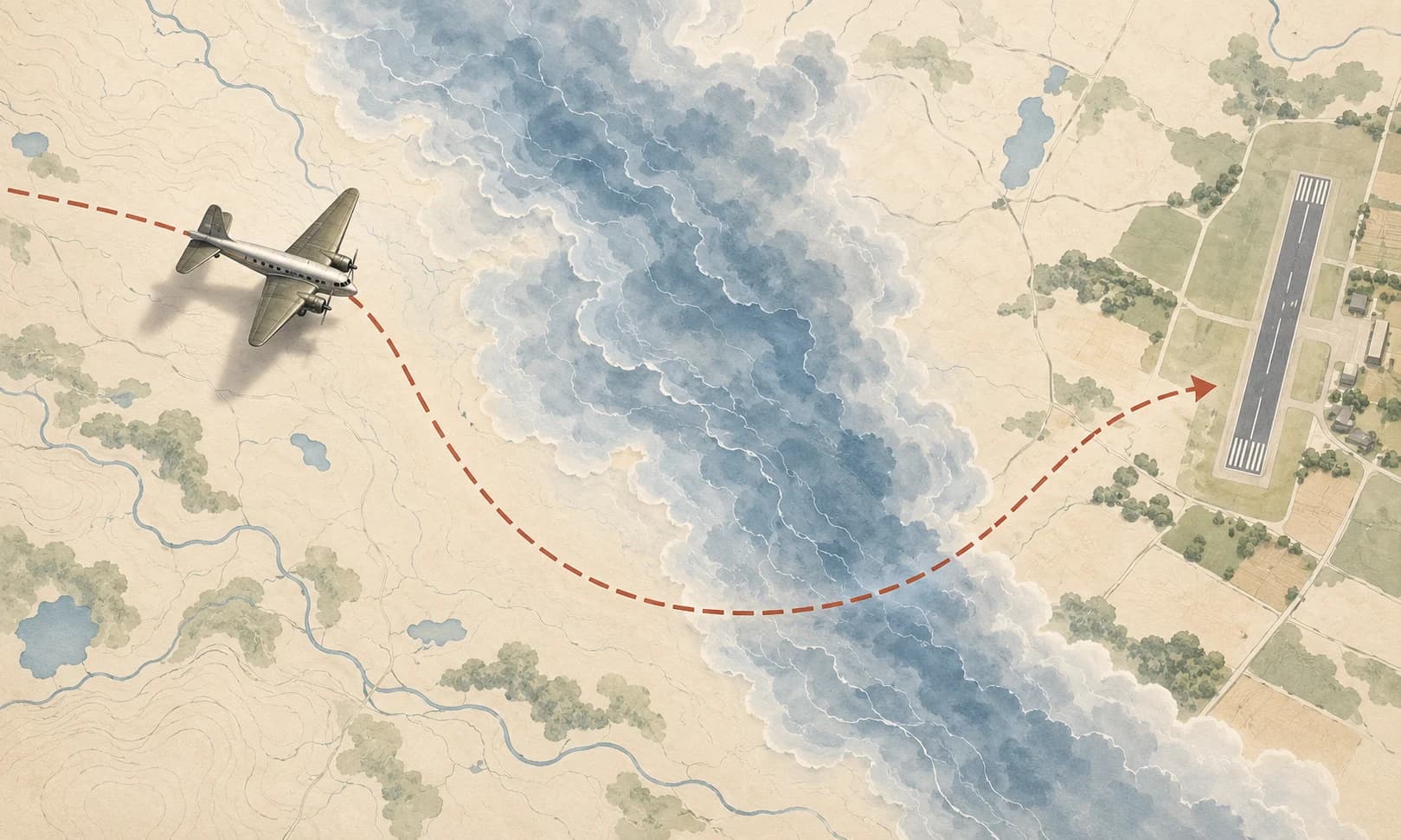
That is the link to Sun Tzu’s sentence. Munger did not study danger for its own sake. He used it to help the pilots reach the benefit they were trying to achieve: completing a mission and returning safely. The next illustration is a conceptual model of that reasoning, not a reconstruction of a specific wartime flight or its measured data.
What changes when the forecast changes?
Set the weather and fuel conditions. Watch how identifying a hazard changes the route—and whether that route is still workable.

Reroute around the icing
The destination is still reachable in this illustration. Knowing where the hazard lies changes the route and makes the desired arrival more achievable.
This simplified model leaves out real flight-planning variables. It illustrates one idea from Munger’s recollection: recognizing a danger is useful when it helps you choose a workable way to reach the goal.
Put the attractive part and the cost in the same frame
The same habit can make everyday decisions clearer. Before choosing, name the gain you hope to get, then trace what must be spent or put at risk to reach it. Also ask what it costs to stay where you are. Inaction is a real option, but it is not always a free one.
| Decision | The hoped-for gain | Costs of acting and waiting |
|---|---|---|
| Take a new job | Higher pay, growth, a better role | Commute, workload, probation risk, less flexibility; staying may mean little growth or income change |
| Start a business | Independence, a useful product, future income | Cash and time before sales, customer access, recovery options; waiting may delay useful learning |
| Make an investment | Potential return or a financial goal | Possible loss, liquidity, concentration, time horizon; doing nothing may also carry a cost |
This is not a case for waiting until risk disappears
No serious choice comes with complete information, and trying to remove every uncertainty can become its own mistake. The question is not “Can I make this risk zero?” but “What would make the gain impossible, how much can I bear before that happens, and what can I learn before I commit more?”
Sometimes the cost of acting now is limited, while the cost of staying still is rising. In that case, the sensible next move may be to act—perhaps through a small trial, a short commitment, or a clear point at which to review the decision. Seeing the downside can make action more decisive because you know what to watch and where to stop.
The other side matters too. A choice may promise a large reward but depend on conditions you cannot control, a loss you cannot absorb, or a recovery path that does not exist. Recognizing that early is not pessimism. It is part of knowing what the opportunity is asking of you.
A short check before a consequential choice
Before making a major decision, write down the answers in plain language. Leave a question open if you do not know yet; an unanswered question is useful information, not a reason to guess.
What benefit am I actually seeking?
Name the result, and how you would know it had happened.
What must be spent to reach it?
Include money, time, energy, trust, and opportunities you would give up.
What could prevent the benefit from arriving?
Look for the few conditions that would make the plan fail or leave you unable to recover.
Can I carry those costs—and what does inaction cost?
Compare the likely path, a difficult but plausible path, and the cost of not moving.
What is the smallest useful next step?
Choose a test or limit that can teach you something before the commitment becomes hard to reverse.
To understand the gain, understand what it takes
Sun Tzu’s line does not ask us to stare at the worst case. It asks us not to separate an attractive result from the cost of producing it. Once both are visible, we can reject a poor trade, change the plan, test an assumption, or move ahead with clearer limits.
That is why knowing the harm can help us use the benefit well. The point is not to become afraid of action. It is to know what action truly costs—and whether what we hope to gain is worth, and can survive, that cost.
For a decision you are facing, what cost would change your view of the benefit—and what would it cost to wait?
Chinese original and the creator's independent translation, Chapter 02.
Open the source chapterFurther reading
- 2020 Daily Journal Corporation Annual Meeting — Charlie Munger remarks transcriptMunger’s recollection of his wartime meteorology work and using inversion to think about icing and fuel exhaustion. The account is his retrospective description, not an independent performance evaluation.
- Charles T. Munger — Caltech Alumni AssociationBiographical background on Munger’s Army Air Forces service and meteorology training at Caltech in 1943. It does not identify a wartime forecasting award.